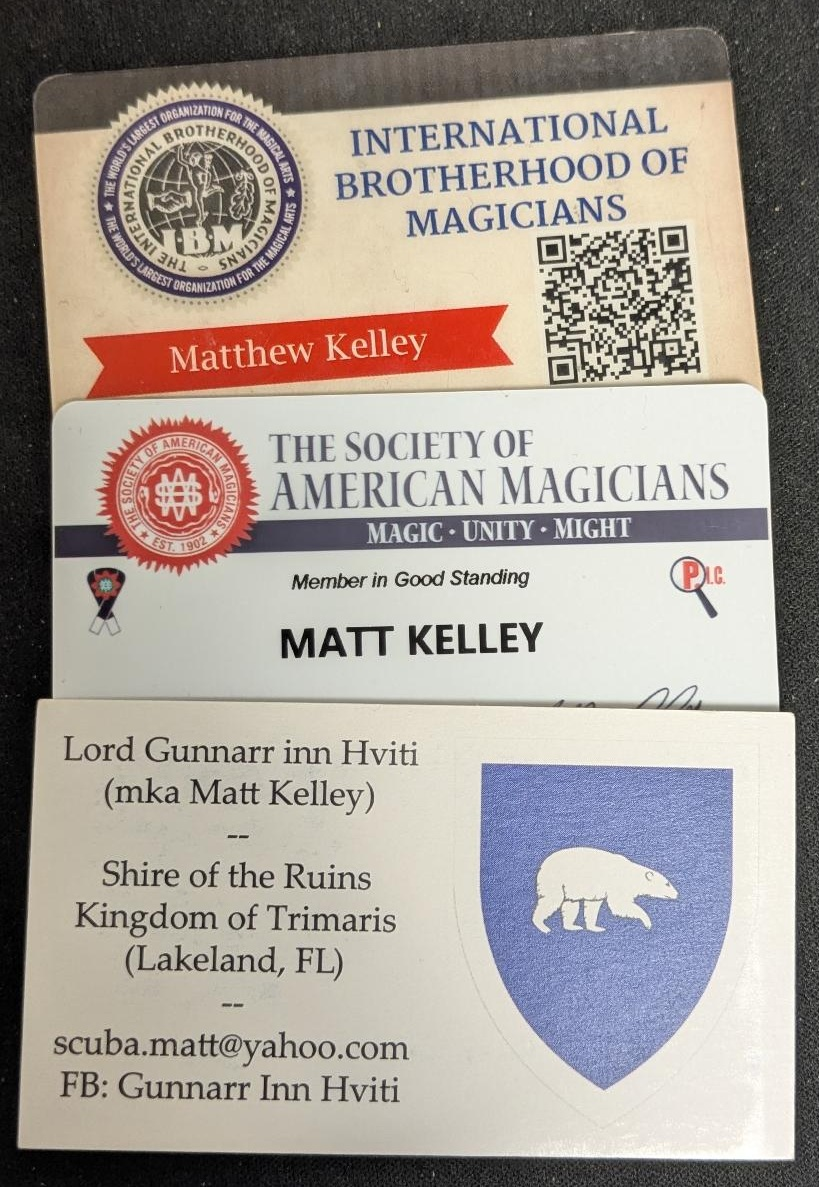

As a member of two professional magic associations, I strive to follow their code of ethics in all aspects of my magical research or performance. This page explains the code and how I apply it.
The Magician’s Code of Conduct – The Rules That Guide How I Do What I Do
I’m an amateur magician, but I’ve belonged to two professional organizations for magicians for over a decade. These are the International Brotherhood of Magicians (IBM) and the Society of American Magicians (SAM). These organizations developed and promote a code of ethical behavior for magicians, called the Joint Ethics Guidelines. Each organization expects its members to adhere to these ethical principles and to educate non-members to the need to adhere to these ethical precepts. Here is the exact wording of the code:
The International Brotherhood of Magicians and the Society of American Magicians join in recommending that all magicians adhere to the following code of ethical conduct:
1. Oppose the willful exposure to the public of any principles of the Art of Magic or the method employed in any magic effect or illusion.
2. Display ethical behavior in the presentation of magic to the public and in our conduct as magicians, including not interfering with or jeopardizing the performance of another magician, either through personal intervention or the unauthorized use of another’s creation.
3. Recognize and respect for rights of the creators, inventors, authors and owners of magic concepts, presentations, effect and literature, and their rights to have exclusive use of, or to grant permission for the use of by others of such creations.
4. Discourage false and misleading statements in the advertising of effects and literature merchandise or actions pertaining to the magical arts.
5. Discourage advertisement in magical publication for any magical apparatus, effect, literature of other materials for which the advertiser does not have commercial rights.
6. Promote the humane treatment and care of livestock used in magical performances.
Even though I do not perform magic for a living, I try to follow those guidelines while I pursue my study of magic within both the SCA and my private life. Since educating non-members is part of subscribing to the Code of Conduct, let me explain what each of the above means, to me.
Number 6 is pretty clear – if you use any living thing in your magic performances, you need to treat them well. Since I am passionate about the welfare of pets and animals in general, this is a no brainer. I do not use live animals in any of my magic, and have no particular plans to do so in the future, but if I do I will treat them with the same love and care as a beloved family pet.
Number 4 means don’t lie to people when advertising your magic gimmicks or other ‘for sale’ items. I don’t sell anything, but I agree with this wholeheartedly. I still remember being bitterly disappointed by Sea Monkeys as a child. Look it up, it was a long time ago, when kids bought things advertised in comic books.
Numbers 3 and 5 are related – don’t use other magician’s legal property (including their routines that fall under copyright) without their explicit permission. Don’t sell stuff that belongs to them. If you use something with their permission, acknowledge it. If you are basing your original work off another magician’s idea(s), give them credit for the inspiration. For me, that includes not purchasing cheap knockoffs of original work, or illegal copies of DVDs and so forth. It’s stealing from magicians, and it’s wrong.
Number 2 is about not being a jerk while someone else is performing. Don’t interrupt or disrupt another performer’s act. Don’t copy another performers act and perform it illegally, or so poorly that it affects future shows. Don’t give away the secrets to another magician’s performance, which relates to item number 1. This is simply the Golden Rule “treat others as you would wish to be treated” and I do my best to respect my fellow performers, because I expect them to respect me.
Number 1 is the most controversial rule, and the one that is open to interpretation in wildly different ways. The basic idea is that magic is about performing an effect that bewilders or amazes the audience. If you give away the secret method used to create the effect, it no longer entertains or amazes. So, as a magician, I’m not supposed to share the secrets of what we do, to anyone, for any reason. Not the actual techniques, not even the principles behind the techniques, not ever. That is the literal reading of the first rule listed in the code of ethics. However, that poses a couple of problems.
First, the logic breaks down. If nobody ever reveals how its done, how do you make new magicians? If I buy a book on magic, and it includes instructions in performing tricks, is the author violating rule 1? How could any magician sell his original magic trick without being in violation? Teller, famous as the silent partner in the magical duo Penn & Teller, has an outstanding commentary on this subject that I have posted elsewhere.
Second, I study magic within the SCA with the intention of performing it (and perhaps inspiring others to take it up). A huge part of the Arts & Sciences process is to document, then share information about whatever it is that you do. In fact, to ever achieve the highest level of recognition for my skill (“Laurel” status) will be virtually impossible without teaching and documenting methods. I should have chosen something easier to document, like ancient Egyptian mummification processes, but magic is much more fun.
So, my personal interpretation of Rule One is that I won’t give away how other magicians do things (don’t interfere with another magician, Rule 2), and I won’t share how I do things with ‘the public’ which I take to exclude ‘people who want to learn how to perform magic’. When documenting research for A&S, I will try to limit the information revealed to the lay audience, even for tricks that are literally hundreds or thousands of years old. On my website, where I expect to have some visitors who are magicians and some who are not, I will try to segregate sensitive information behind a password system, or use terms that are not explicitly obvious to the lay audience. If it is necessary to provide documentation or ‘proof’ of my research, I can limit that exposure to those with a need to know.
What the above means is that certain areas or entries in my website will require password access to view, and they will be clearly marked as such. If you think you should have the password, contact me and we will set it up (or not, at my discretion).